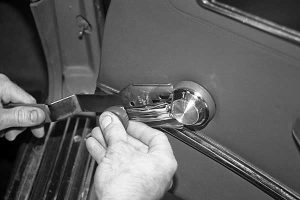
<p>A stuck exterior door handle on a classic muscle car can turn a quick cruise into a frustrating puzzle. Whether your handle moves freely without opening the door or refuses to budge at all, the cause is almost always in the linkage, latch, or handle assembly itself. These cars use simple mechanical systems, which makes diagnosis straightforward once you know where to look. This guide covers the most common failures and how to fix them without damaging original parts.</p>
<h2>Common Causes of a Stuck Exterior Door Handle</h2>
<p>Classic muscle cars from the 1960s and 1970s rely on a mechanical rod-and-lever system connecting the exterior handle to the door latch. Age, wear, and poor lubrication create predictable failure points.</p>
<ul>
<li><strong>Worn or broken plastic clips:</strong> The rods attach to the handle and latch with nylon or plastic retainers. These become brittle and snap, leaving the rod disconnected.</li>
<li><strong>Bent or misaligned linkage rods:</strong> Years of slamming doors and vibration bend the rods out of adjustment.</li>
<li><strong>Dried grease in the latch assembly:</strong> Old grease hardens into a waxy paste, freezing the latch mechanism.</li>
<li><strong>Broken handle return spring:</strong> The handle flops loosely and may not engage the rod properly.</li>
<li><strong>Worn latch pawl or striker:</strong> Internal latch components wear out, preventing the release mechanism from tripping.</li>
<li><strong>Frozen or corroded lock cylinder:</strong> The lock linkage can jam the release rod if the cylinder seizes.</li>
</ul>
<p>Identifying which of these applies begins with observing how the handle behaves.</p>
<h2>Initial Diagnosis: Read the Handle's Behavior</h2>
<p>The way the handle moves tells you a lot before you remove a single panel.</p>
<ul>
<li><strong>Handle moves freely with no resistance:</strong> The rod is likely disconnected or the clip broke. The handle isn't engaging the latch.</li>
<li><strong>Handle moves partially and stops hard:</strong> The linkage is binding or the latch is jammed.</li>
<li><strong>Handle won't move at all:</strong> The handle pivot is seized, or the lock mechanism is blocking travel.</li>
<li><strong>Handle works from inside but not outside:</strong> The fault is isolated to the exterior handle, rod, or its clips.</li>
</ul>
<p>Once you have a symptom pattern, remove the interior door panel to access the linkage. On most muscle cars, this means removing the window crank, armrest screws, and door panel clips. Work carefully—original panels and clips are fragile.</p>
<h2>Inspecting and Repairing the Linkage</h2>
<p>With the panel off, you can see the full path from handle to latch. Follow these steps:</p>
<ol>
<li><strong>Operate the exterior handle while watching the linkage.</strong> Look for a rod that fails to move or a clip that has popped off.</li>
<li><strong>Check every plastic clip.</strong> Replace any that are cracked, missing, or loose. Reproduction clips are inexpensive and widely available.</li>
<li><strong>Grip the rod and manually push it toward the latch.</strong> If the door opens, the problem is in the handle-to-rod connection.</li>
<li><strong>Inspect for bends.</strong> Compare the rod to its original shape. Straighten minor bends carefully with a small adjustable wrench.</li>
<li><strong>Adjust rod length if applicable.</strong> Many muscle cars use threaded adjustment or a bendable rod to set release timing. Adjust so the latch trips fully when the handle is pulled.</li>
</ol>
<p>If the rod moves the latch but the door still won't open, the problem is inside the latch assembly itself.</p>
<h2>Servicing the Latch and Handle Assembly</h2>
<p>The latch is the most common source of intermittent or total failure on older cars.</p>
<ul>
<li><strong>Clean and lubricate the latch:</strong> Remove it from the door if necessary. Soak it in solvent, scrub away hardened grease, and relubricate with white lithium grease or a dry PTFE spray.</li>
<li><strong>Check the release pawl:</strong> Ensure it moves freely and returns under spring tension. A stuck pawl prevents the latch from releasing the striker.</li>
<li><strong>Inspect the striker alignment:</strong> A misaligned striker can bind the latch. Loosen the striker bolts, adjust, and retighten.</li>
<li><strong>Rebuild or replace the handle:</strong> If the handle pivot is worn oval, the rod geometry changes. Rebuild kits or reproduction handles restore proper travel.</li>
<li><strong>Address the lock cylinder:</strong> If the lock linkage interferes with the release rod, disconnect the lock rod temporarily to confirm. Repair or replace the cylinder as needed.</li>
</ul>
<p>For stubborn latches, work the mechanism by hand repeatedly while applying lubricant until it moves smoothly through its full range.</p>
<h2>Preventive Maintenance and Reassembly Tips</h2>
<p>Once the door opens reliably, take steps to keep it that way.</p>
<ul>
<li>Lubricate latch mechanisms, rod pivots, and handle pivots annually with white lithium grease.</li>
<li>Replace all brittle plastic clips during any door service—they fail without warning.</li>
<li>Avoid slamming doors; it accelerates wear on clips, rods, and latches.</li>
<li>Keep spare clips and a spare rod in your toolbox, especially on long trips.</li>
<li>Test the handle from outside and inside, plus the lock function, before reinstalling the door panel.</li>
<li>Apply a small amount of grease to the door panel clips to make future removal easier and reduce rattles.</li>
</ul>
<p>For cars with power locks or remote systems added later, verify that aftermarket actuators aren't interfering with the factory rod travel.</p>
<h2>Conclusion</h2>
<p>A stuck exterior door handle on a classic muscle car is usually a linkage, clip, or latch problem rather than a major failure. Start by observing how the handle behaves, then remove the door panel and trace the linkage from handle to latch. Replace worn clips, straighten bent rods, and clean and lubricate the latch assembly. With regular lubrication and careful reassembly, your door will open smoothly for years of driving.</p>